Bottom line first: on the map of automated money-making, two things genuinely changed in 2026 — GitHub moved its big payouts into an invite-only VIP tier (the public channel’s critical cap dropped to $10K, and the qualifier round has begun), and Huntr turned open-source bounties into an AI attack/defense tournament (a $15K prize pool, which happens to be the direction my existing pipeline can most easily be ported to). And every one of those pretty “market size” numbers collapsed the moment it went through the three-vote adversarial check — that meta-lesson is worth more than any single conclusion.
How this came about
I already have a 24-hour automated bug bounty hunting loop that’s been running for half a month (lynxGHSL, a systemd timer firing every 4 hours, 3 reports submitted so far), plus a full self-use automation stack: content pipeline, monitoring, control plane. The question follows naturally: beyond security bounties, what other currencies can “automated code modification / automated workflows” be exchanged for? RMB, USD, anything.
This post answers that with one round of deep research via Grok. Let me lay out the method up front, so you don’t end up trusting the wrong things:
- Broke it into 5 search angles (Grok search as primary, Tavily as fallback — Grok timed out 3 times along the way)
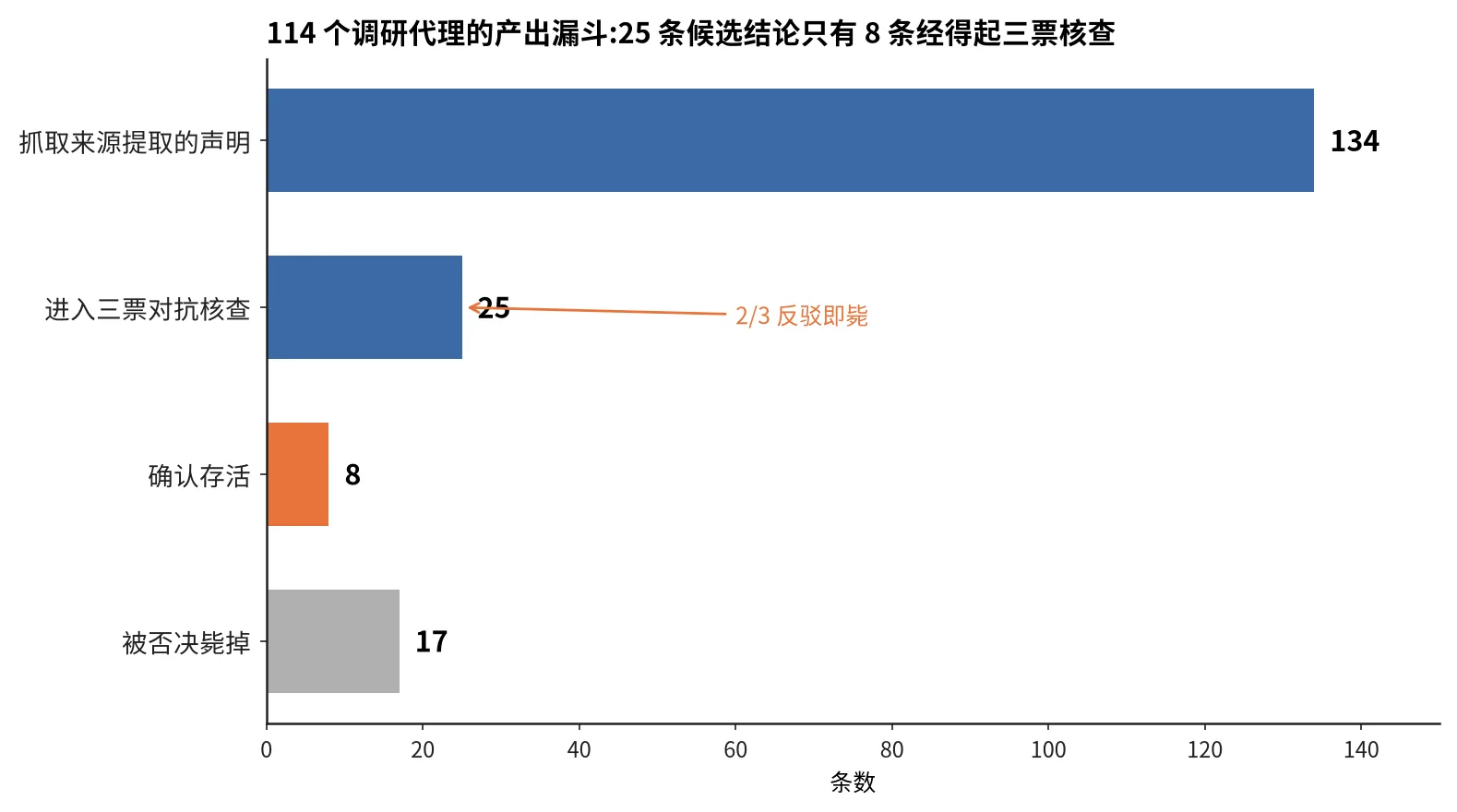
- Pulled the source text of 31 sources and extracted 134 falsifiable specific claims (platform names, amounts, thresholds)
- Picked the 25 most critical, assigned 3 independent verifiers to try to refute each one; 2 of 3 refutations kills it
Result: 8 confirmed, 17 killed — a 68% kill rate. The 17 that got killed are just as valuable; section three is devoted to them.
1. Monetization channels that survive verification
1.1 GitHub Bug Bounty got restructured — time to relearn the rules (high confidence)
In late July 2026, GitHub restructured its bounty program, with two key changes (official announcement, bounty.github.com):
- The critical cap for public programs is now a flat $10,000. The “$30K+ for critical” figure that used to circulate only holds for the invite-only VIP private program.
- The bar to enter VIP: a cumulative total of at least 1 critical, or 2 highs, or 4 mediums, or 7 lows. This one was confirmed 3-0 unanimously.
The implication for me is direct: my hunting loop currently targets third-party open-source libraries (via the GHSL channel), which is a separate track from GitHub’s own program. But “bank 1 critical and you’re into VIP” is a clear ladder rung — criticals inside VIP start at $30K, three times the public program.
1.2 Huntr has become an AI security challenge platform (high confidence)
huntr.dev is no longer the old “submit an open-source vuln, get a little cash” platform. It now centers on time-boxed AI/ML security challenges: the currently running “Inside Job” challenge has a $15,000 prize pool, and the task types are AI-specific vulns like guardrail bypass, agent secret extraction, and unauthorized execution; the top 30 on the leaderboard take $70–$1,600 by rank. It’s also been acquired by Protect AI, with Palo Alto Networks and Hugging Face behind it.
The key judgment: these “attack the AI agent” contests are highly isomorphic to my existing automated audit pipeline — both are about finding sinks, building PoCs, and validating exploit chains. The only difference is that the target has shifted from traditional code to LLM applications. This is the new battlefield where reusing existing infrastructure is most likely to pay off fast.
1.3 Automated agents winning bounties is already proven, not theoretical (medium-high confidence)
XBOW (an automated pentesting agent) hit #1 on HackerOne’s US leaderboard. This one passed 2-1, but with a footnote: it’s a self-reported result, and on a filtered leaderboard (US-only, org-type-only). Even discounted, the signal is clear: submitting bounty reports via automated agents is a proven path — we’re past the “can AI do security?” debate and into the “whose pipeline is more efficient?” competition.
1.4 Freelance markets: automation workflows and AI agent work have real price ranges (medium confidence)
Cross-referenced data from Upwork/Fiverr/Toptal: automation script/bot development at $100–$1,500 per project; AI agents built from scratch at $30–$250/hour, starting at $5K and reaching six figures for large projects. Note these are list prices, not average transaction prices, and nobody has audited actual close rates — but they’re good enough as a floor reference.
My version isn’t taking gigs on those platforms. It’s this: package my existing pipeline capabilities (control plane, content production funnel, monitoring) into a service and sell it to small and mid-sized businesses at home — for example, an automated publishing pipeline for WeChat Official Accounts / Xiaohongshu, which is exactly what I already use myself, at near-zero marginal cost.
1.5 Vertical micro-SaaS is the only AI business model still raising money (medium confidence)
The core conclusion of an industry analysis: investors have stopped looking at generic wrapper products; only AI micro-SaaS with “vertical use case + proprietary workflow + proprietary data” is still getting funded. Another hard constraint worth remembering: AI costs eat 40–70% of revenue, making the gross margin structure far worse than traditional SaaS — which means anyone building AI SaaS without their own model access is handing all the profit to upstream APIs. For someone holding a pool of free open-source model channels and a key library, this constraint is actually the loosest.
1.6 Prompt/skill marketplaces: selling the “automation recipe” itself (medium confidence, amounts not strongly verified)
Two leads I pulled (not put through the three-vote gauntlet; flagged as reference only):
- PromptBase: selling prompts, authors keep 80%, top sellers make $500–$5,000/month;
- Agensi: a skill marketplace for GitHub Copilot, with 4,000+ skills and 350+ creators selling globally.
The essence of this category is turning “I know how to build automation” into a replicable, sellable asset. The agent skill packs I write day to day (the main bounty-hunting flow, the video pipeline, one-click deployment) are, in theory, merchandise for exactly this market.
1.7 Outcome-based pricing is the new paradigm for charging for AI agents (medium confidence)
Industry examples: Intercom Fin charges $0.99 per resolved ticket (you’re paying for an outcome, not for software); Bland.ai bills per AI call minute. The takeaway for solo developers: instead of selling subscriptions, package your pipeline as a “pay per successful delivery” service — e.g. “X yuan per issue successfully fixed,” “Y yuan per qualifying video generated.” The natural fit between this billing model and automation pipelines is that machines don’t sleep, and there’s no ceiling on piecework.
1.8 GitHub Sponsors: mature but slow (medium confidence)
Official data: zero commission on personal accounts, 6% on organization accounts; 49,000+ developers have benefited, top tiers reach $12,000/month, and cumulative payouts exceed $50 million. Conclusion: good as supplementary income for an open-source project, not as a primary strategy — unless your project already has a real user base.
2. Checking this against my own hand
| Conclusion | What I already have | Gap |
|---|---|---|
| Third-party OSS bug bounties | 24h automated loop, 3 reports submitted | Maintainer verification pass rate still to be observed |
| GitHub official bounty VIP | Nothing | Need to bank qualifying findings first; viable as a long-term goal |
| Huntr AI challenges | Nothing | The nearest new frontier: isomorphic to the existing audit pipeline |
| Freelance automation services | A full self-use pipeline | Missing commercial packaging and a first paying customer |
| Vertical micro-SaaS | Model channel advantage | Missing a chosen vertical |
| Prompt/skill marketplaces | Plenty of ready-made skill packs | Missing the act of listing them |
| Outcome-based billing API | API site infrastructure | Billing model not designed yet |
Three shortest paths, ranked by effort-to-return:
- Huntr AI challenges (days to start): extend the existing vuln fingerprint library with a set of AI-specific categories (guardrail bypass / secret extraction), then run the current loop against the live challenge tasks.
- List skills (weeks): pick 3–5 of the most mature skill packs, clean them up, and list them on Agensi-style marketplaces.
- Turn the pipeline into a service (months): pick one of my self-use content pipelines and find a first seed customer to validate a per-item billing model.
3. The 17 that got killed: market research reports are basically untrustworthy
This was the most instructive part of the round. All of the following were rejected 0-3 or 1-2:
- A whole cluster of numbers from one market research shop: “AI coding assistant market at $6B, growing 22% a year,” “Copilot at 4.7M subscriptions, $900M–$1.1B ARR,” “Cursor at $2B+ ARR” — the entire set from the same source was wiped out. Three verifiers couldn’t find a single first-hand source.
- A Zapier vs. Make pricing comparison: “$19.99 for 750 tasks is 6x more expensive than Make” — 0-3. Pricing pages change constantly; secondhand write-ups are guaranteed to be stale.
- “AI pentesting raised $665M in VC,” “560+ automated agents submitting to HackerOne” — 1-2, the numbers couldn’t be traced to a source.
- A research firm’s AI testing market size forecast ($1.01B → $4.64B) — 1-2.
- Even something as seemingly checkable as “Nuclei supports AI-generated templates” got killed 0-3 (the verifiers found the claim didn’t match the actual repo).
The lesson is identical to my last research round on ERP: any article citing market research firm numbers should first raise the question, “who audited that?” Secondhand pricing comparisons, size forecasts, and growth CAGRs have a survival rate near zero. The numbers that survive share common traits: official announcements, official pricing pages, government/IPO filings.
Final thoughts
The real landscape for automated money-making in 2026 is this: security bounties are undergoing structural change (the public channel is depreciating, a new AI attack/defense arena is opening), service monetization is the same as ever (slow but steady, and it comes down to marginal cost), and the “market size” information circulating on the internet is far worse in quality than you’d imagine.
For solo developers with automation infrastructure, my advice boils down to one sentence: take what you’re already running every day and find the nearest place it can be charged for. My loop’s nearest fit is Huntr’s AI challenges; yours may