Bottom line first: What I’m missing isn’t another orchestration tool—it’s a “Control Plane”: a coordination layer that answers, in one place, “which pipeline, which version, which run, which step blew up, how many retries, and when it fires next.” cron just yells “it’s time” and walks away. After hands-on research across 11 platforms, my choice: Windmill as first pick, Kestra tied as alternate; n8n/Temporal/Argo explicitly ruled out; Hermes gets repositioned as a scheduled Agent, not the scheduler.
Background first: what my automation stack actually looks like
My automation setup is the classic “pile of scripts” shape: 17 cron jobs, 13 systemd timers, 17 Docker containers, Python/Shell scripts scattered across six or seven directories, plus an AI content pipeline (RSS → fetch → LLM judgment → rewrite → publish → Telegram notification). It runs, but it has a pile of structural problems:
- Workflows are a total black box—cron fires the script, and what happens inside is anyone’s guess
- Workflow scripts and monitoring scripts are two separate systems, each logging on its own
- The pipeline crashed once and it took me three days to work backward from “why hasn’t the public account updated?”
- The same pipeline shows up as
workflow_final / workflow_final2 / workflow_new2—which version is actually running in production is anyone’s guess - Agent workflows are especially hard to trace—the steps happen inside the LLM’s tokens
I boiled these pain points down to four orthogonal problems: missing execution semantics (no concept of run/task/state), missing signals (no “fail → push”), a distorted world state (version and deployment are out of sync), and the Agent black box.
Layer first, then choose
One conviction held throughout this research: don’t cram these platforms into a single leaderboard—they’re not even on the same layer.
| Layer | Definition | Platforms |
|---|---|---|
| Automation / Integration | Event-driven connector orchestration | n8n |
| Workflow Orchestrator (Control Plane) | Scheduling + orchestration + DAG + run state + versioning + audit | Kestra, Windmill, Prefect, Airflow |
| Data Orchestrator | Centered on data assets / lineage | Dagster |
| Durable Execution | State persistence, precise recovery | Temporal, Hatchet, Inngest |
| Agent Runtime | Hosts LLM sessions / tool calls | Hermes, Claude Agent SDK |
What I want is the second layer—the control plane. Once you’ve split by layer, a lot of “should I adopt this?” questions answer themselves: n8n isn’t bad, it’s just not on the layer I need.
Research methodology: every fact verified online on the spot
Conclusions need to survive re-checking, so this time I didn’t go on vibes:
- One research agent per platform, 11 in total, checking each project’s latest GitHub release, official docs, and architecture docs, with every version number pinned to 2026-08-22
- Adversarial verification agents for the top 6, whose sole job was to find errors. And they did: a wrong release date for the latest Temporal version—the kind of pit you can’t catch by “impression”
- Verification itself is recursive: the first verification round concluded that “Prefect secrets are stored plaintext in the database,” but a second round against the official v3 docs found that contradicts the official wording “encrypted at rest.” I corrected this in the body and walked Prefect’s score back from 7.9 to 8.0 (ranking unchanged). If you can catch others’ mistakes, you should be able to catch your own
- After publication, a group member pushed back on “multi-step tasks”, so I added a second round: the multi-step semantics of six platforms were all verified against official first-party material (schema pages / the OpenFlow spec / docs source in the official repos), cross-adjudicated by four verification agents, and I spot-checked the key syntax word by word against the source—and this round caught my own mistake: the
{{ outputDir }}usage in my earlier POC is now marked deprecated in current docs (replaced by outputFiles), and the script task’s image field changed fromdocker:tocontainerImage - I also did a read-only inventory of my own machine, so the migration plan rests on the real setup rather than imagination
Latest stable versions verified: Kestra 1.3.30 (Apache-2.0), Windmill v1.795.0 (AGPL-3.0), Prefect 3.8.3 (Apache-2.0), n8n 2.35.7 (Sustainable Use License), Dagster 1.13.19, Temporal v1.31.2, Airflow 2.10.3, Argo v4.1.2, Hatchet v0.101.27, Inngest 1.43.0.
Finals: weighted scoring and revisions
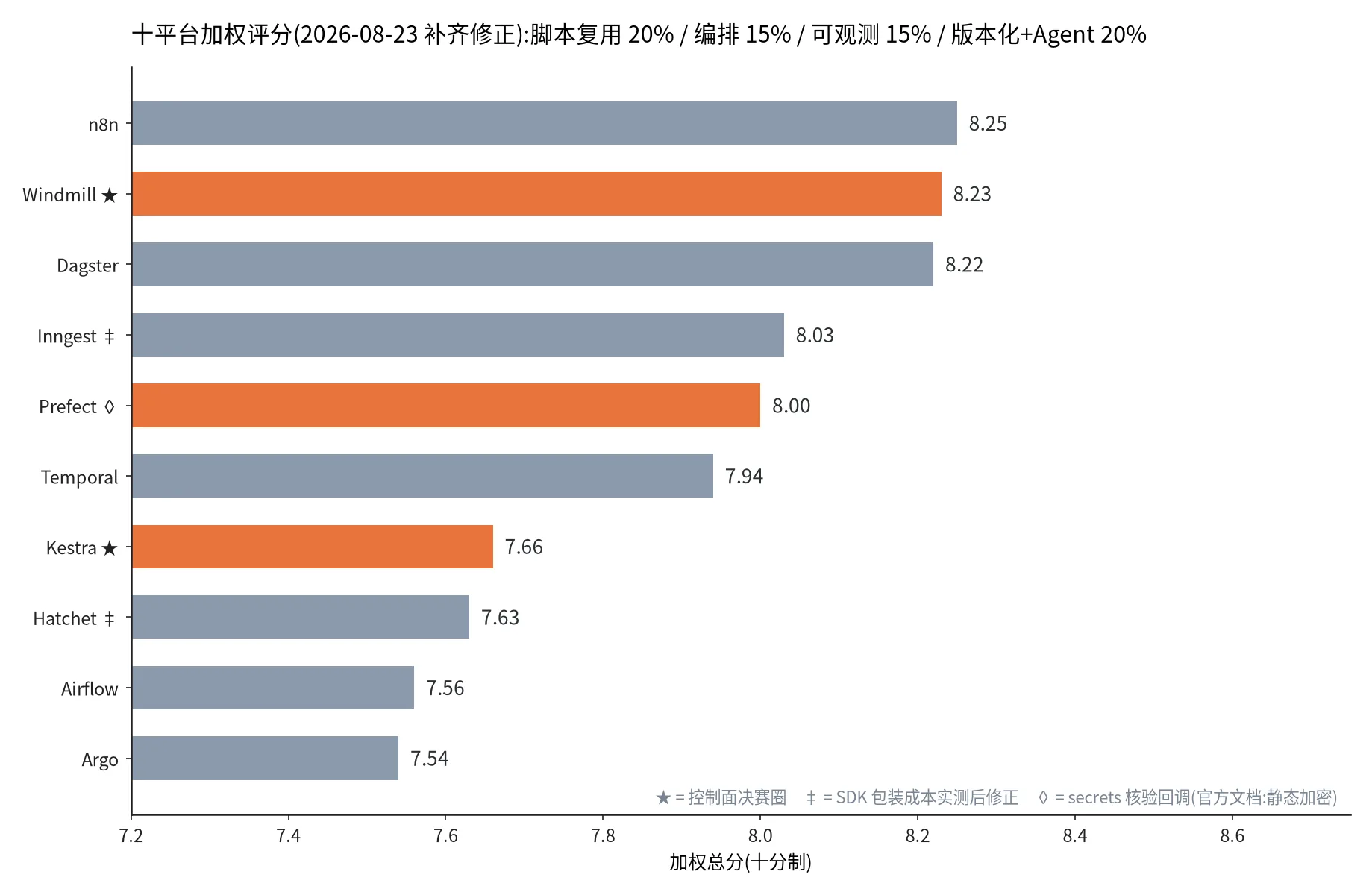
I set weights based on my own priorities: script reuse 20%, orchestration 15%, observability 15%, versioning 10%, Agent workflows 10%, the rest spread across other factors. Weighted results (out of 10):
| Platform | Weighted score | In one line |
|---|---|---|
| Windmill | 8.2 | Scripts are first-class citizens, native Git Sync → first pick |
| Kestra | 7.7 | One YAML declares every bit of run semantics, Apache-2.0 → tied alternate |
| Prefect | 8.0 | Best Python experience, versioning is the hidden weak spot → third |
| n8n | 8.3 | Highest score, but the license and JSON workflows make git review an uphill battle → not a control plane |
| Dagster | 8.2 | Strong, but the asset paradigm mismatches my content pipeline |
| Temporal | 7.9 | Retry semantics champion, at the cost of rewriting every script as an activity |
| Airflow / Argo | 7.6 / 7.5 | Ops paradigm too heavy (Argo requires K8s) |
| Inngest | 8.0 | After follow-up research (scripts must be wrapped in step.run, 42 LOC + worker) |
| Hatchet | 7.6 | After follow-up research (scripts must be wrapped in SDK tasks, 8-12 LOC each + a long-running worker) |
The right to interpret scores belongs to judgment: the initial leaderboard gave Inngest/Hatchet 8.3+, but those were scores that hadn’t accounted for SDK wrapping costs. I then ran a second round of adversarial verification plus migration-cost measurement for both—Hatchet requires wrapping every shell script as an SDK task (measured: 8-12 lines of glue + a long-running worker container, plus cron has no timezone, no pause, and loses schedules on downtime), Inngest requires wrapping in a step.run handler (42 lines of glue + worker)—and after measurement I revised them to 7.6 and 8.0. More dramatically, the re-check also overturned one of my own initial verification conclusions: Prefect’s secrets—the official v3 docs explicitly say “encrypted at rest,” which contradicts what I’d written (“plaintext in the DB”); I corrected it and walked Prefect back up to 8.0 (ranking unchanged). Costs a weight table can’t capture can only be filled in by measurement; even verification itself must be re-verified—which is exactly a proof by contradiction of the value of Windmill/Kestra treating scripts as first-class citizens.
Why I’m explicitly not using those others
- n8n: the strongest drag-and-drop integration platform, 500+ connectors. But my git-versioning requirement collides with its JSON workflow definitions—diffs and reviews are painful; the Sustainable Use License also makes long-term dependence uncomfortable. It’s the Automation layer, not a control plane.
- Temporal: the de facto standard for Durable Execution, peerless at precisely resuming tasks that span hours. But my pipeline has no such hard requirement, while its costs (SDK-ifying everything + multi-service ops) are certain; another often-overlooked deduction: its Web UI only shows the scheduling event stream, application logs don’t go in, and per-step logs require building your own export—details in the multi-step section below. When the hard requirement appears, wrap only that one sub-pipeline.
- Argo: a very proper K8s workflow, but I live on WSL2 single-machine + docker-compose, and standing up K8s for it would be putting the cart before the horse.
Hermes’s proper place: an Agent, not the helmsman
My Hermes (multi-model TG gateway) has a built-in cron and a WebUI, but it has no workflow DAG, no versioned workflows, no run semantics—it’s born to be an Agent Runtime. The right posture: the control plane calls it as an “agent task” (HTTP/CLI/MCP), and scheduling, retries, timeouts, and versioning all stay in the control plane. That way I can use Hermes today and swap in Claude Code headless tomorrow without changing a single line of the control plane.
The group member’s pushback: what multi-step tasks actually look like
After the post went out, a group member hit my soft spot in one sentence: the example you gave only has “scheduled trigger → run one script → retry rules → failure rules,” with nothing like GitHub Actions’ “one job, many steps.” The fault here is mine—to prove “low cost of onboarding,” I picked the shortest possible snippet and ended up hiding the control plane’s single most important value. This section puts it back, and directly answers the mental model he proposed: a task should be defined in steps, and from the moment of trigger, every step has run logs that can answer “which step is it on now, which step did it fail on, and how did each step run.”
Let me give the conclusion first: this model isn’t an “extra requirement”—it is the definition of a control plane. Kestra and Windmill (and Prefect) all satisfy it natively; what’s truly counterintuitive is that if you treat “per-step logs, out of the box” as a hard metric, the king of retries, Temporal, is the first to be eliminated—details below.
Five questions, answered in one pass by the run view
Break the group member’s mental model into five questions and check them against the run views of the two finalists:
| The group member’s question | Kestra (two-level Execution / TaskRun view) | Windmill (Run view) |
|---|---|---|
| Did this trigger fire? | Schedule table + Execution list: each trigger spawns an execution, recording trigger type and time | Schedules + Runs list: past runs and next scheduled time |
| Did the task complete? | Execution status: SUCCESS / WARNING / FAILED | run status and total duration |
| Which step is it on now? | Every TaskRun has its own status, updated in real time | Run tree marks each module in real time |
| Which step did it fail on? | The failed TaskRun is called out separately, and the same page shows how far upstream succeeded | Failed module turns red, upstream green, downstream gray |
| How did each step run? | A dedicated logs page per TaskRun + attempt count + inputs/outputs preview | Dedicated logs per module + retry count + result values |
Everything in this table is available in both vendors’ Community editions (I verified each item against official docs)—not Enterprise-exclusive.
Along with a full picture of one run (what you see when step 2 fails):
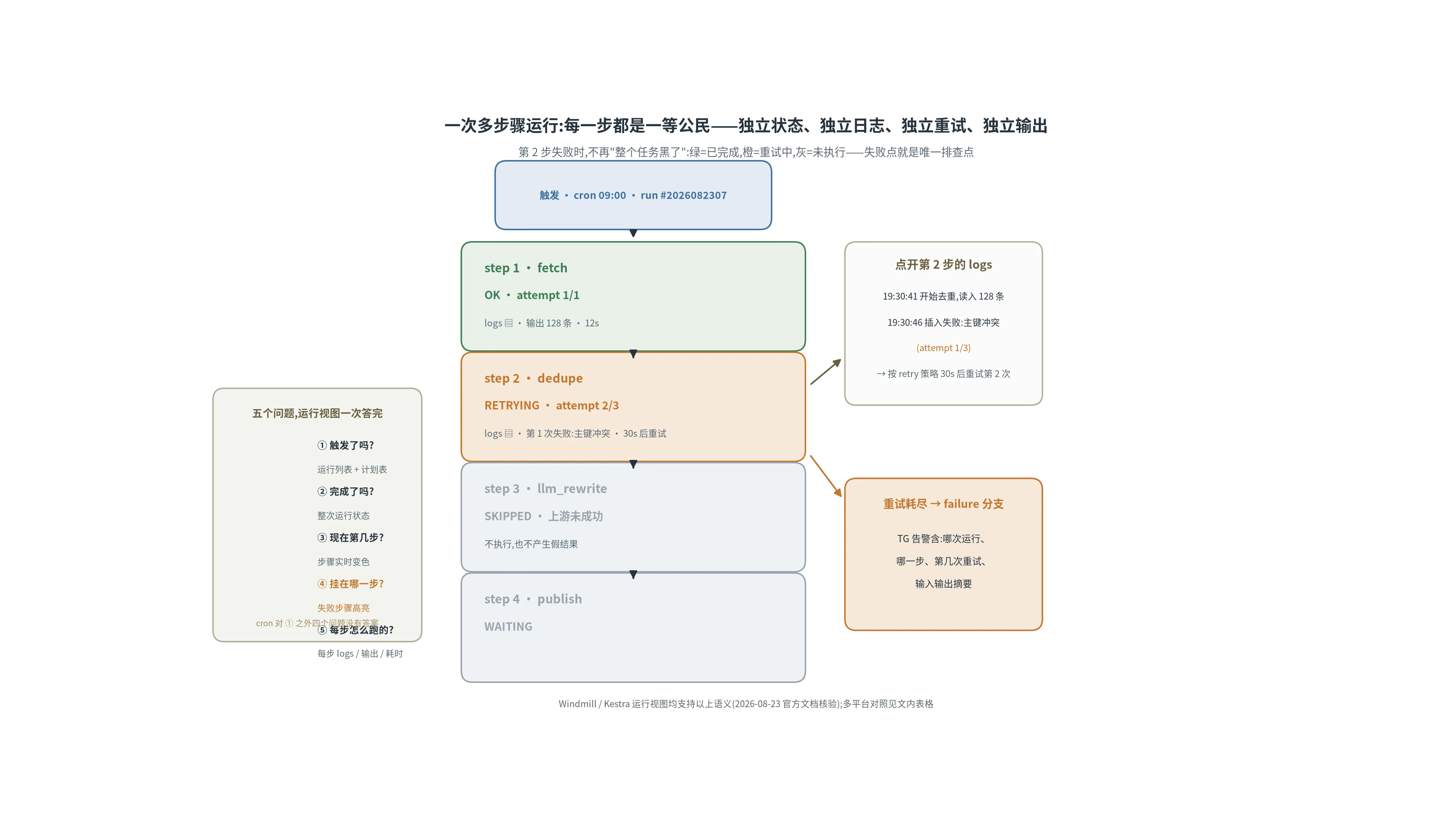
Of these five questions, cron can only answer “when does it trigger next”—the other four are all black boxes. That’s the entire meaning of the phrase “control plane.”
The real multi-step form: the same pipeline, two ways to write it
Kestra—one YAML declaring four steps, each with its own retry and timeout, passing artifacts between steps via outputFiles, and after retries are exhausted, the errors branch names the exact step in its alert:
| |
Windmill—existing scripts register as resources with zero changes, the flow handles the wiring; each module’s retry/timeout/data hand-off is a module-level field:
| |
Step shapes can get even richer: parallel (branchall), looping (forloop), and “stop at a step and wait for human approval” (suspend, then continue on a reply event)—all module-level configuration that doesn’t change the scripts themselves. Kestra has counterparts: the Parallel task, and an errors branch that can hold arbitrary script/HTTP tasks.
“Define tasks by their final artifacts”: right direction, but mind the boundaries
The group member’s second argument was “define tasks by their final artifacts.” Taken literally, the closest platform is actually Dagster: it explicitly models each artifact as an asset, links assets by dependencies, and leaves a production record for every run. That’s precisely why I originally filed Dagster under the “data orchestration layer” and didn’t pick it as my control plane: asset modeling’s comfort zone is data tables/datasets, while half of my setup consists of side-effect-y steps like “push a TG message, restart a container, call a publish API”—they have no “artifact,” and forcing asset semantics onto them is cutting the foot to fit the shoe.
In a control plane, “artifacts” exist in lightweight form and that’s already enough: Kestra gives every task typed outputs (previewable in the UI, referenceable downstream), and Windmill gives every module a result (auto-persisted, referenced downstream via results.<id>). So the route to final artifacts is natural: large artifacts (generated PPTs, MP4s, images) get uploaded to object storage by the publish step itself, and the control plane is responsible for “did it reach that step, what did that step produce, and where did it go”—exactly the job of upload-artifact in GitHub Actions, with no need to bring in an asset-lineage engine for it.
Migration principle: onboard first, don’t change scripts
Not a single line of these scripts gets rewritten right now. Four phases: the platform went live on single-machine docker-compose on 2026-08-23 (Windmill, localhost:8760); this week, onboard the first real pipeline and run it for 7 days; weeks two through four, migrate the high-frequency cron jobs (vendor_watch, node liveness), and with each migration, delete the corresponding cron line in the same commit; in month two, all 17 cron jobs are onboarded, secrets move from .env into the platform, and monitoring scripts become flows with alerts too; in month three, hook up Langfuse to expose LLM token spend. The full report (with all scoring rationale and verification corrections) lives in a private repo.
Ten conclusions
- What’s missing is a control plane, not a tool; 2. Windmill first pick, Kestra tied alternate—either one will do; what readers want, “multi-step + per-step independent logs/retries,” is the default shape for both, not a bonus feature; 3. Prefect only overtakes once workflows are 90% Python-ified; 4. n8n stays for “third-party SaaS integration” scenarios, not used now; 5. Adopt Temporal only when a hard requirement for precise, hours-spanning resumption appears (and remember it has no built-in log aggregation—per-step logs need a custom export); 6. Hermes is a scheduled Agent, not the scheduler; 7. Langfuse is a phase-two must (token/cost is the control plane’s blind spot); 8. Don’t install Grafana/Loki early—get platform-native UI + Telegram alerts running smoothly first; 9. Keep cron only for system-maintenance-level jobs, add not a single new business cron; 10. The platform is already live (single-machine compose, localhost:8760, 2026-08-23), so only one thing is left this week: onboard the first real pipeline and get failure alerts working end to end.
Research limitations: each platform’s score comes from a single research agent (eight of them passed adversarial verification; Hatchet/Inngest also got wrapping-cost measurements; Airflow/Argo did not pass, so read their scores with a wider confidence interval); the multi-step semantics were filled in by a second round on 2026-08-23 (official docs verification across six platforms + adversarial verification, with key syntax spot-checked word by word against official schema pages/repo source); all versions and licenses are per official GitHub/docs as of 2026-08-22. References: Kestra official docs, Windmill official docs, Prefect v3 docs, Temporal Releases, n8n docs, Dagster Releases.