
2026 F1 Hungarian GP: Strategy Wins Where Speed Alone Falls Short
In 2026, Formula 1 rolled out an entirely new set of regulations: a new power unit, new aerodynamics, and even the overtake-assist DRS system has been scrapped outright. Some are calling it “the biggest change in F1 in fifty years.”
And the Hungarian Grand Prix on July 26 turned out to be the most vivid lesson in that transformation — it laid bare the battle between speed and strategy under the new rules: a 22-year-old rookie, starting from P7, led the race at one point and finished on the podium.
We拆 open this race corner by corner using official telemetry data.
1. Race Result: A Strategy Winner’s Race
| Position | Driver | Qualifying | Race | Change |
|---|---|---|---|---|
| 1 | Norris (McLaren) | P1 | P1 | 0 |
| 2 | Verstappen (Red Bull) | P4 | P2 | +2 |
| 3 | Antonelli (Mercedes) | P7 | P3 | +4, biggest gain |
| 4 | Leclerc (Ferrari) | P2 | P4 | -2 |
| 5 | Hamilton (Ferrari) | P5 | P5 | 0 |
| 6 | Russell (Mercedes) | P6 | P7 | -1 |
Norris led from pole to the flag, never looked back. But the real story was behind him: rookie sensation Antonelli came from P7 to stand on the podium — the biggest qualifier-to-finish gainer of the race.
2. The Protagonist: Antonelli’s Rollercoaster Race
If you只看 his position graph over the race, it looks like an ECG:
- Lap 1: P6
- Lap 16: Into the top 3
- Lap 21: Led the race!
- Then bounced back and forth between P1 and P5 for several laps
- Final: 3rd place
Why such wild swings? Because race outcomes are never just about raw speed — they’re about when you pit for tyres. Every pit stop reshuffles the order; pitting early or late, fighting for track position versus preserving your rubber, it’s a constant arithmetic problem. Every time Antonelli “led” the race, it was a strategy gamble that paid off.
3. Tyre Strategy Showdown: Why the Fastest Lap Didn’t Win the Race
This is the part that slaps the “speed-only” narrative in the face.
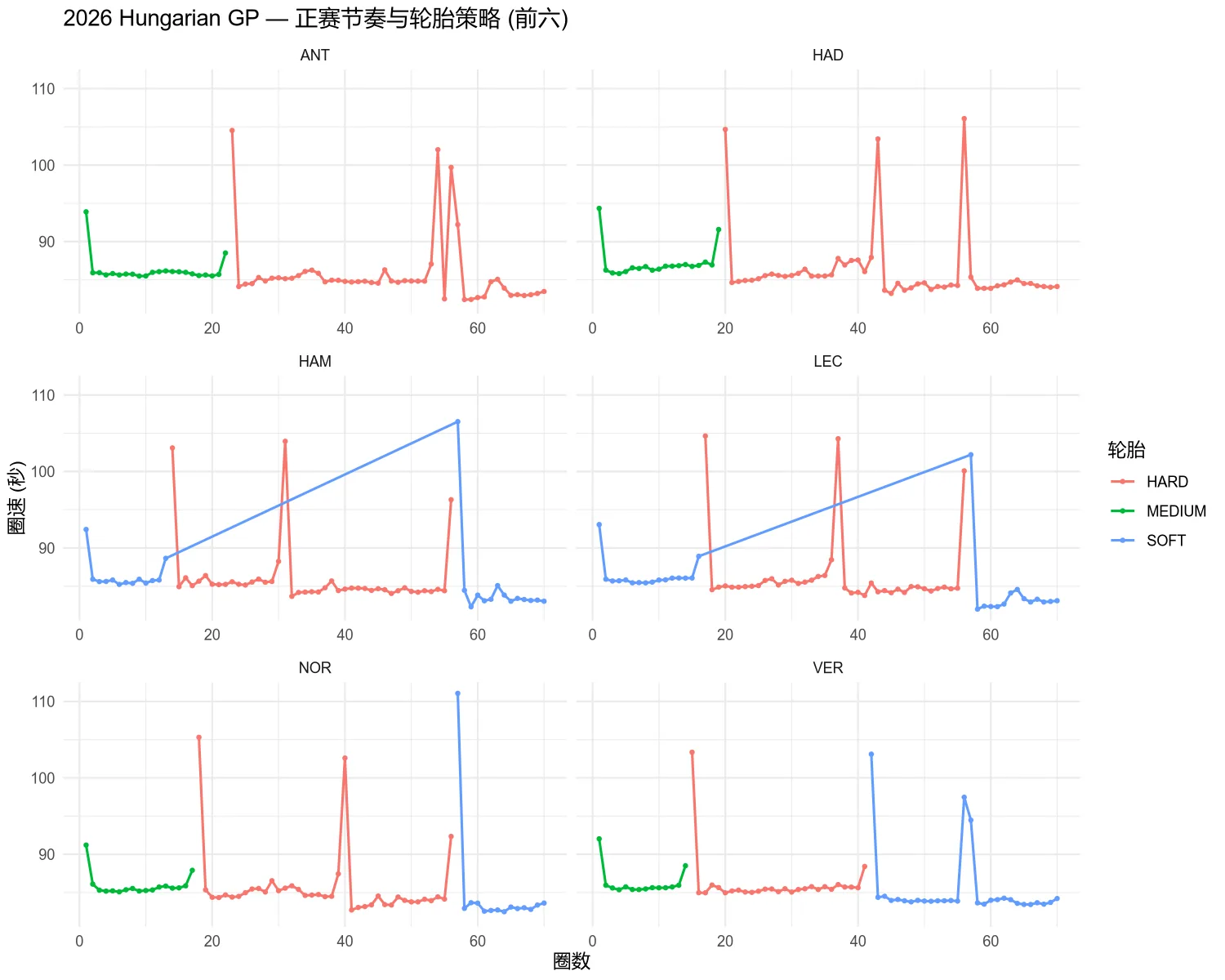
First, the data: who had the fastest lap of the race? Leclerc, 1:22.000, on softs in lap 58. And he finished P4.
Now the strategy board:
| Driver | Tyre Strategy | Fastest Lap |
|---|---|---|
| Norris | M→H→H→S (3-stop) | 1:22.49 |
| Antonelli | M→H→H (2-stop, ran old hards for the last 18 laps) | 1:22.42, 2nd fastest |
| Leclerc | S→H→H→S (3-stop) | 1:22.00, fastest |
| Hamilton | S→H→H→S (3-stop) | 1:22.30 |
Both Leclerc and Hamilton went with a “soft start + 3-stop” aggressive approach, changing tyres most frequently, and their flying laps were indeed the quickest — but where did that get them? P4 and P5, respectively.
Antonelli, on just a 2-stop, pushed through the final 18 laps on worn hards and still managed the 2nd fastest lap of the race. Same speed, different strategy, vastly different results.
Hungary is notorious for being a “no-passing, pit-stop-is-everything” circuit, and this race took that trait to the extreme: the fastest car doesn’t have to win — the most efficient one does.
4. New Regulations: We Saw the End of the DRS Era With Our Own Eyes
One of the biggest changes in the 2026 regulations: DRS (Drag Reduction System, which allowed the rear car to open a flap on the rear wing when within one second of the leader, boosting straight-line speed and serving as the primary overtaking aid for over a decade) has been officially retired, replaced by an active aerodynamics system.
This shift left an unmistakable mark in the telemetry data we pulled: the DRS field is entirely zeroes.
For the past decade, DRS was the single most critical variable in overtaking data. By 2026, it has vanished from the data dictionary entirely. So what drives overtaking under the new rules? It comes down to corner-speed differentials, strategy windows, and driver bravery. This Hungarian Grand Prix is the first sample of a new overtaking era.
5. The Micro-Battle: Where Did That 0.26 Seconds Come From?
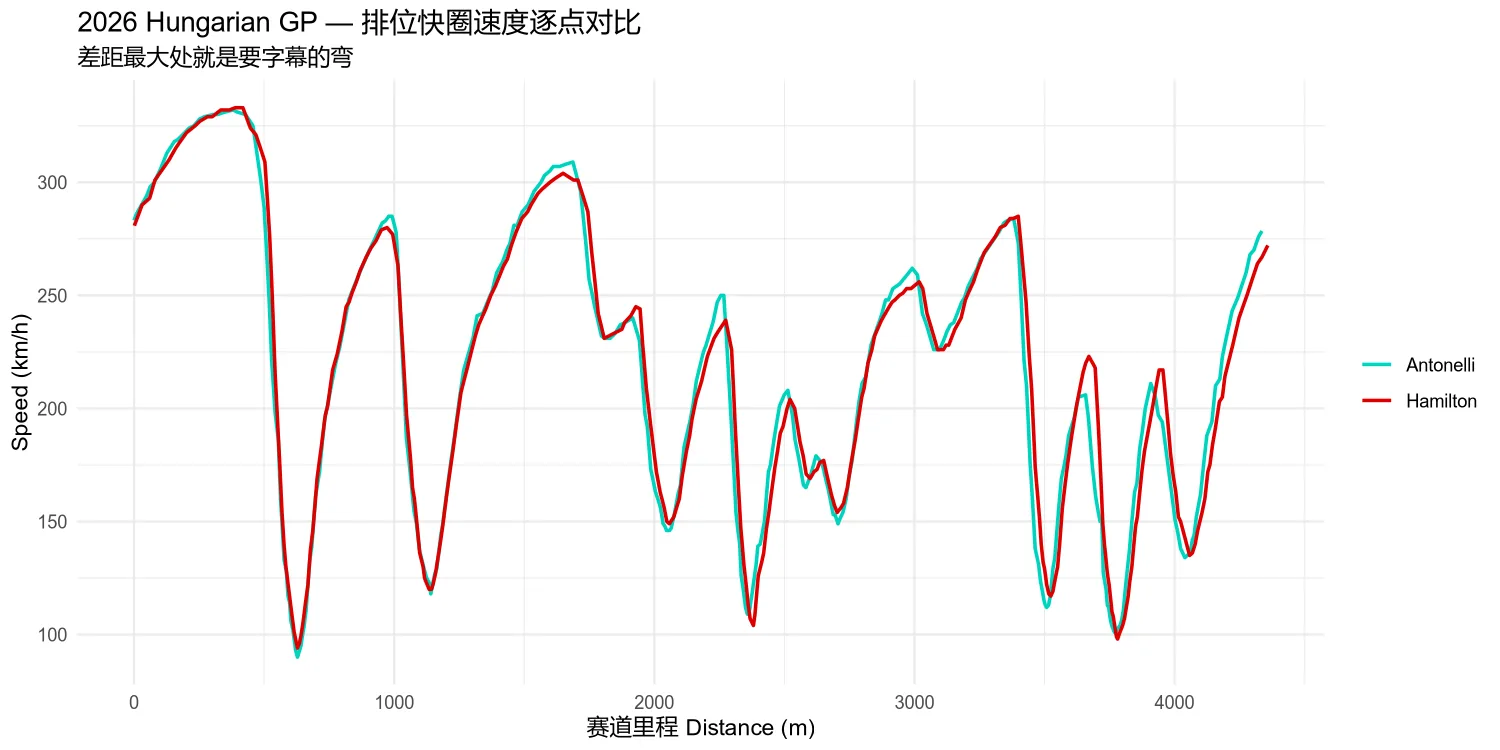
Aligning Antonelli and Hamilton’s fastest laps point by point (telemetry interpolated by distance), Hamilton was quicker by 0.26 seconds and averaging 0.56 km/h faster overall. Top speed was nearly identical — 332 vs 333 km/h. The gap wasn’t on the straights.
Broken down by sector:
- Around the 3,250m mark: Hamilton averaged 12 km/h faster per sector — this was Antonelli’s hardest corner
- Around the 4,250m mark (the finish straight): Antonelli fought back, edging ahead by 11.5 km/h
Same track, same new-spec cars, identical top speed, yet each driver has their own cornering strengths. This is where driver style diverges under the new regulations — and the data pinpoints it corner by corner.
Appendix: How We Did It (Data Methodology)
- Data source: F1 official timing data, obtained via open-source tools (fully available for the 2026 season)
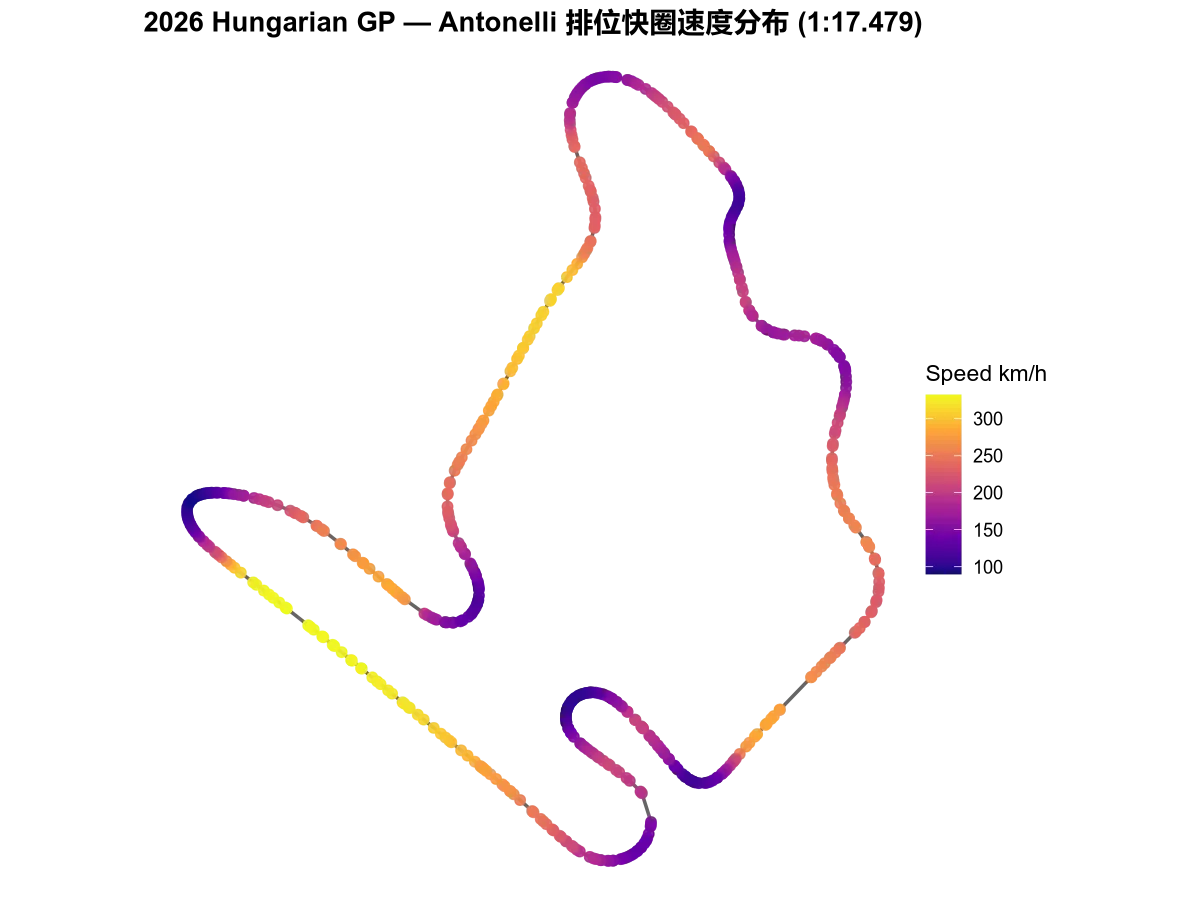
- Telemetry resolution: ~590 sample points per lap, covering speed, throttle, brake, gear, RPM, and GPS coordinates
- Data cleaning: Raw data contained outlier laps (a 21.9-second anomaly — a Hungarian lap is ~82 seconds); filtered per F1 rules
- Analysis tools: R / Python, with interpolation-based alignment for corner-by-corner comparison
If you’re interested in motorsport data or data-driven decision-making, follow us — we’ll be publishing after-action analyses every race weekend.
This article is data-driven and is not an official race report. Data source: F1 official timing data.