
Key Facts at a Glance

- September 28, 2026: U.S. personal AI agent startup Instinct announced its $1 billion funding round
- Post-money valuation: $10 billion (≈RMB 67.1 billion)
- Lead investors: Sequoia Capital, Benchmark Capital, and Coatue
- Company structure: A product of Spear Street Technology, operating with only 14 employees
- Founder: Noah Shinn, age 23; dropped out of Northeastern University in 2023
- Product status: Early access phase with limited user rollout
The Anomaly: Valuation Jump in a 14-Person Team

Instinct’s valuation surged fourfold within one month, from $2.5 billion to $10 billion—a rare pace even in today’s AI boom. This acceleration came despite the company’s extremely lean team size of just 14 people, creating an unusual valuation-to-employee ratio.
This discrepancy is noteworthy: traditional early-stage AI startups typically require dozens to hundreds of engineers before reaching a $1 billion valuation. The market’s willingness to assign such a premium suggests strong conviction that personal AI agents could become the next dominant user interface layer, displacing both mobile apps and search-based interactions.
In August 2026, Instinct was still pursuing a $250 million Series B round at a $2.5 billion valuation. Just one month later, it closed a $1 billion round at $10 billion—representing both a 4× valuation increase and a 4× funding increase over original expectations.
Product Comparison: Instinct vs. Meta Muse
Instinct and Meta Muse share similar goal of automating personal tasks, but differ in architectural approach and user experience.
| Feature | Instinct | Meta Muse |
|---|---|---|
| User interaction | SMS and phone call based, using native communication channels | Built into Meta’s social messaging ecosystem (WhatsApp, Messenger) |
| Execution environment | Operates with access to user’s email, calendar, messages, screen, audio, location | Runs inside Muse Secure VM for isolated execution |
| Task complexity | Concierge service handles complex real-world tasks like calling restaurants, signing up for dental waitlists, managing bills | Focuses on standard tasks: shopping, travel, email management |
| Multi-agent coordination | Trusted Person Network allows different user agents to communicate and coordinate directly | No publicly announced cross-user agent cooperation |
| Target audience | Early individual users open to granting broad permissions | Broad consumer base via Meta’s installed user base |
Sandbox = isolated execution environment limiting agent’s system access; VM = virtual machine, a software emulation of a physical computer
Who Should Try It Now?
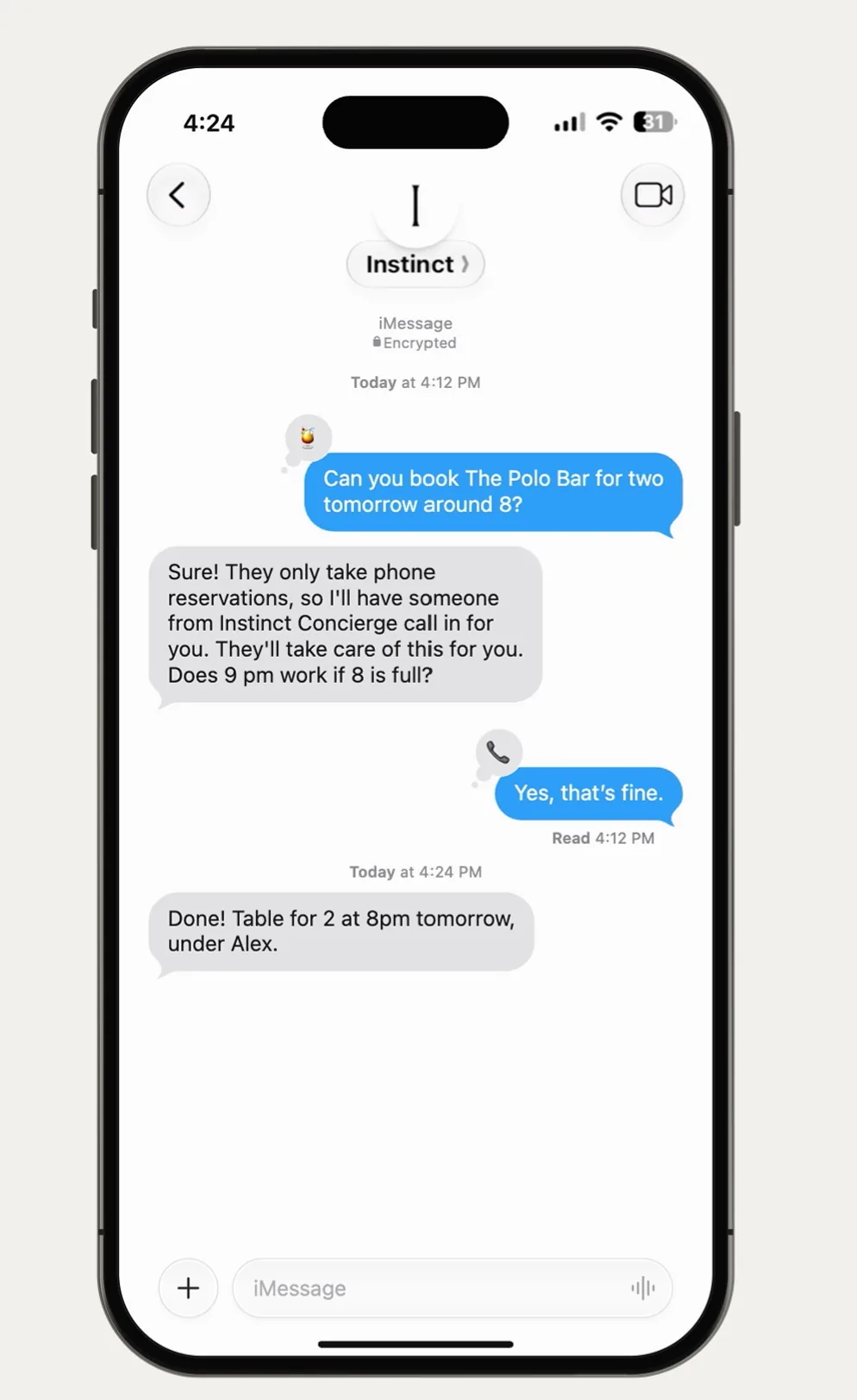
Good candidates to test early:
- Users frequently handling non-digitized tasks (booking restaurants without online queues, managing cable bills, signing up for phone service)
- Comfortable granting email, calendar, and financial app access in exchange for time savings
- Technically savvy enough to understand current limitations and set usage boundaries proactively
Wise to wait:
- Privacy-conscious users unwilling to share sensitive data with third-party agents
- Users needing legally binding actions where responsibility is unclear (Instinct’s terms permit using user data to train models)
- Critical business operations where verification of agent actions remains challenging
Security features deployed: Isolated sandbox execution, short-lived local credentials, and identity-signature tools. Instinct’s latest active detection system can identify subtle hallucinations during response generation—and block errors before execution. However, high-permission tasks remain user-authorized by design.
Final Word
The high valuation reflects belief that personal AI agents will replace traditional apps as the primary user interface layer. The key competitive frontier now shifts from question-answering to task orchestration capability, with execution fidelity becoming the new differentiator. If this trajectory holds, personal AI assistants may dominate daily productivity tools within three years—but mass adoption hinges not on technical prowess alone, but on establishing clear boundaries around permissions, accountability, and data stewardship.